
Exterior Walls Protected and Finished to Last
Siding Installation in Moline for residential and commercial properties with failing, outdated, or unprotected exterior wall surfaces
Original siding on many Moline homes—particularly those built between the 1940s and 1970s—was installed using wood or early aluminum that has since degraded in ways that newer materials were specifically engineered to avoid. Calderon Construction installs siding on residential and commercial properties in Moline, working with vinyl, fiber cement, and wood options to match the material to what the building's structure, exposure, and appearance actually call for. Choosing siding based on upfront cost alone, without accounting for how the material behaves on an older structure with varied sheathing conditions, is where many installations create problems within a few years of completion.
The installation process begins with removing existing siding and inspecting the wall sheathing and house wrap condition underneath. On homes built before modern vapor management was standard, the sheathing layer is often board sheathing rather than plywood or OSB, and the fastening pattern for new siding panels has to account for that substrate. Water-resistive barrier material is installed or replaced at this stage, before new siding goes over it, because adding siding over a compromised moisture barrier simply hides the problem rather than correcting it.
Set up an exterior evaluation with Calderon Construction to review your property's current siding condition and discuss which material fits the building correctly.
The Difference Between Siding That Protects and Siding That Just Covers
Fiber cement siding requires different installation handling than vinyl: it's heavier, it must be back-primed on cut edges before installation, and it needs specific fastener types and penetration depths to hold without cracking the panel face. Vinyl siding, by contrast, must be hung with fasteners driven in the center of the nailing slot rather than tight against the edge, because the material needs room to move with thermal expansion or it buckles in visible waves across the wall. These are not preferences—they are material-specific requirements that determine whether the installation holds its appearance and weatherproofing function over time.
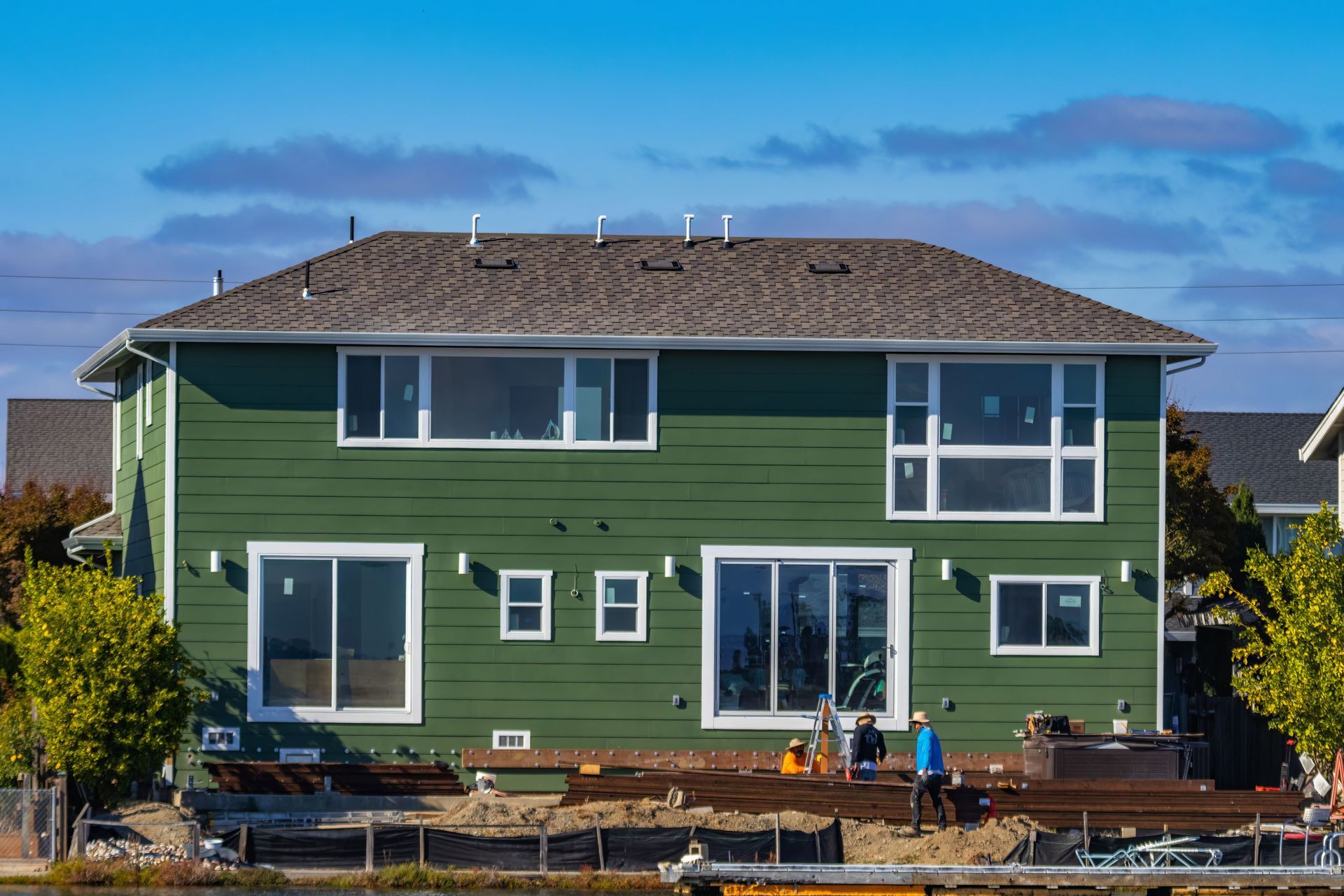
After installation is complete, the finished exterior should show consistent panel alignment with no visible bowing, trim pieces that sit flat at window and door surrounds, and corner pieces that are plumb and sealed at the top edge. Gaps in J-channel at window heads or unsealed tops on outside corner posts are the points where water enters the wall assembly—they're visible on a finished job and indicate where the installation quality stopped short. Calderon Construction finishes trim and transition details as part of the siding scope, not as optional additions.
Material selection also affects what the exterior looks like long-term: vinyl holds color through the material rather than a surface coat, so scratches don't require repainting the way wood or fiber cement does; fiber cement takes and holds paint well but requires periodic repainting on a schedule tied to the paint product used, not an open-ended assumption that it stays finished indefinitely. Understanding those maintenance differences before selecting a material is part of making an installation decision that fits how the property is managed.
What to Know Before and After Siding Is Installed
The questions below focus on how siding installation is performed, what the material and preparation decisions involve, and what property owners should look for in a finished installation.
Why does the wall sheathing condition affect how new siding performs?
Siding is fastened through the sheathing into wall studs, and if the sheathing is deteriorated, delaminated, or missing in sections, fasteners don't hold at consistent depth and the panels can work loose over time. Older homes in Moline with original board sheathing require fasteners long enough to reach the stud through the board layer, which is a longer fastener than standard panel siding installation on modern OSB sheathing.
How is fiber cement siding handled differently at cut edges during installation?
Every cut edge on fiber cement must be back-primed with an exterior primer before installation because the cut face exposes the cementitious core material, which absorbs moisture if left unsealed. Skipping this step causes the cut edge to swell and delaminate, which is most commonly visible at butt joints and around window and door openings where cuts are most frequent.
What is the correct way to install vinyl siding so it doesn't buckle or wave?
Vinyl panels are hung by driving fasteners through the center of the nailing slot with the panel in its natural hanging position—not pulled tight or pushed up before fastening. The panel needs approximately a quarter inch of movement in each direction to expand and contract with temperature changes. Panels fastened tight at the nail slot have no room to move and buckle outward in warmer conditions, which is one of the most visible signs of an improper installation.
How are window and door surrounds detailed so water doesn't get behind the siding at those openings?
J-channel at the sides of windows is installed first, then the head flashing or head J-channel laps over the side channels. This shingle-lap sequence sheds water away from the opening rather than into it. Reversing that sequence—installing head channel before side channels—creates a gap that directs water into the wall behind the siding at exactly the point where window framing is most vulnerable to moisture damage.
What should you look for in the finished installation to verify it was done correctly?
Check that panels are level across the wall, that there is no visible bowing between fastener points, that all trim pieces are fully seated against the wall and sealed at the tops of outside corners, and that J-channel at windows and doors shows a consistent gap between the siding panel edge and the channel bottom—too tight means the panel can't move, too loose means the channel isn't catching water at the edge.
Calderon Construction also installs siding in East Moline, Rock Island, and Milan. Request an exterior evaluation to assess your property's current wall condition and determine which siding material and installation approach fits your building correctly.
Contact Us for a FREE Estimate
Contact Us
We will get back to you as soon as possible.
Please try again later.